
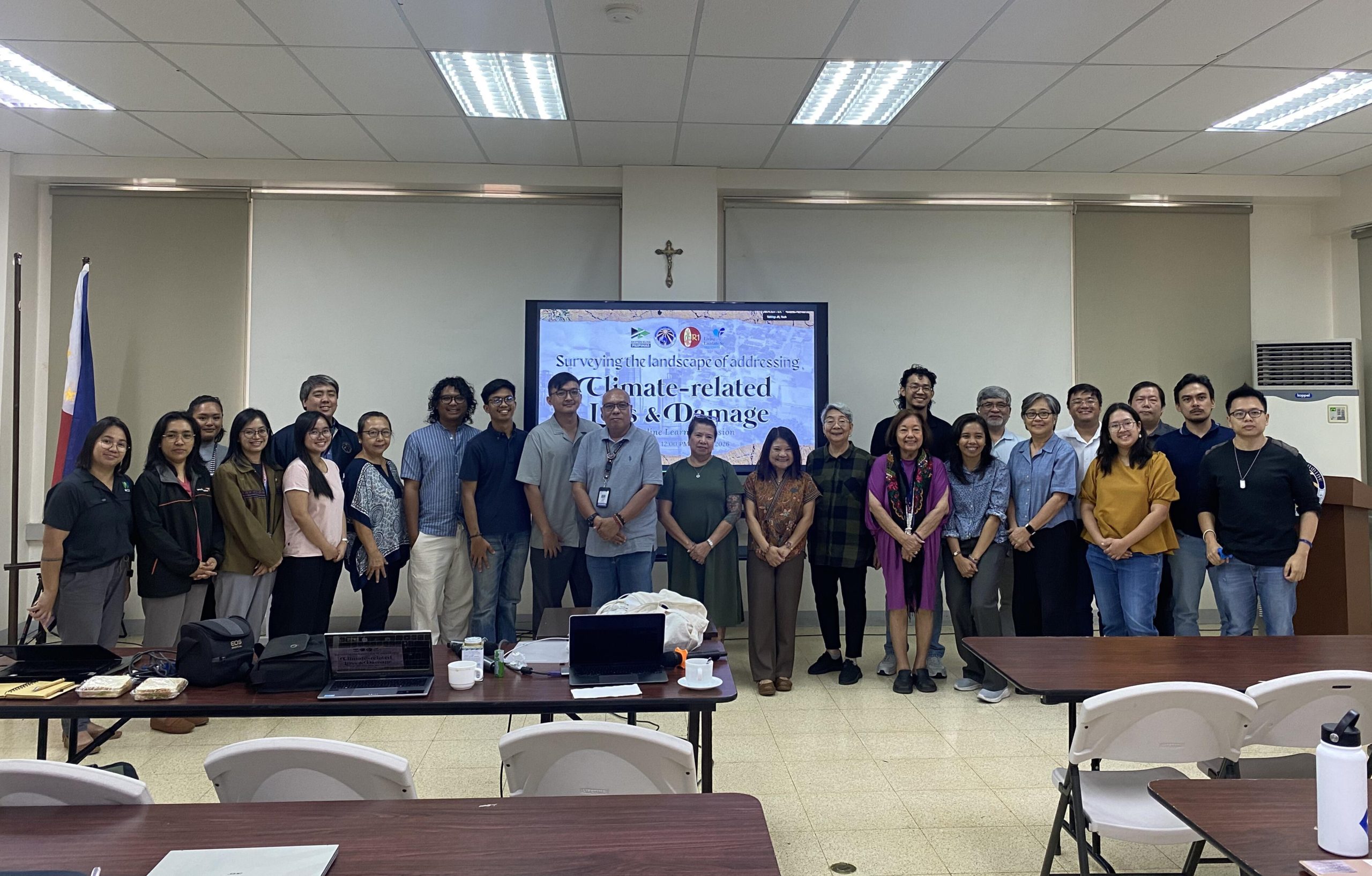
The Klima Center of the Manila Observatory, in partnership with Aksyon Klima Pilipinas (AKP), co-hosted the second Civil Society Convening on Loss and Damage on May 4, 2026. Held at Manila Observatory, the event gathered key stakeholders to strengthen ongoing advocacy work for Loss and Damage (L&D) as a critical climate issue in the Philippines.
Representatives from the government, academe, and civil society delivered presentations highlighting developments related to the Fund for Responding to Loss and Damage, the CLIMA Bill, other relevant climate policies, and overall climate advocacy. Resource persons included Asec. Noralene Uy of the Department of the Environment and Natural Resources (DENR), Ms. Jessica Dator-Bercilla, technical advisor of the Loss and Damage Priority Support Framework, Atty. Ben Galil Te of the Klima Center, Mr. Jefferson Chua of Greenpeace Philippines, Ms. Sylvia Miclat of the Environmental Science for Social Change, and Mr. John Leo Algo of Aksyon Klima Pilipinas.
A key objective of the event was to develop multi-organizational strategies and strengthen the coordination of advocacy groups and other non-government stakeholders in engaging with policymakers. In line with this, the event provided a space for the participants to discuss what an L&D and CSO coordination should look like. Discussions emphasized the importance of CSOs to have a role in the L&D national mechanism in the Philippines which includes participation in consultations and observers in high-level meetings. Participants also highlighted the potential role of non-government stakeholders in coordinating data collection and management, as well as serving as intermediaries for communities’ engagement with government agencies and other duty-bearers.
Moreover, the participants underscored the limited access to proposal writing due to its technical nature. To address this, participants suggested exploring pooled funding mechanisms that could help improve access to funding opportunities while simplifying the reporting process.
Participants likewise identified ways forward for national-level L&D advocacy in the Philippines. They emphasized that a national-level L&D policy in the Philippines should address gaps in accounting, especially on non-economic loss and damage. They also noted that the definition of loss and damage in the Philippine context must have a strong language on reparations and accountability. For sources of funding, some participants suggested relying on stable resource mobilization under FRLD that the Philippines can access and implement through the CLIMA Bill.