
Written by Francis Uldric T. San Juan
Gathering more than 1000 participants in Chiang Mai, Thailand, and virtually, to tackle various aspects of public policy, it was vital to ensure that there was space for the experiences of indigenous peoples.
The experiences and perspectives of indigenous communities must be recognized and amplified – this is a principle that is slowly being integrated into academic conferences and international negotiations. Although historically marginalized and excluded, these indigenous communities are undoubtedly key stakeholders whose voices must be listened to, especially as the world strives to adapt to an increasingly warming world.
Offering unique perspectives and critical analyses on the experiences of Loss and Damage (L&D) of indigenous farmers from Atok, Benguet, Dr. Doreen Allasiw, the Deputy Director of the International Relations Office of Benguet State University, and Mr. Francis Uldric San Juan, a Research Assistant at Klima Center, participated in the recently concluded International Conference on Public Policy (ICPP). Manila Observatory, in partnership with Heinrich Böll Stiftung, conducted a study that looked into the lived experiences of L&D among indigenous farmers, which was published as a policy brief last year. This participation in the international conference allowed the research team to look into various aspects of the study, further examining the case of indigenous farmers in Atok, Benguet.
Dr. Doreen Allasiw, taking a discursive approach in analyzing resilience among indigenous farming communities, presented in a panel entitled “Discursive Analysis for Policy Framing in the ‘Asian Century.’” Mainstream policy framings around resilience and modernization, she contended, often threaten indigenous knowledge systems and exploit the capacity of communities to survive amidst challenges. This was connected to the historical marginalization faced by indigenous groups, noting how American colonization and market liberalization continue to inflict L&D on farming communities.
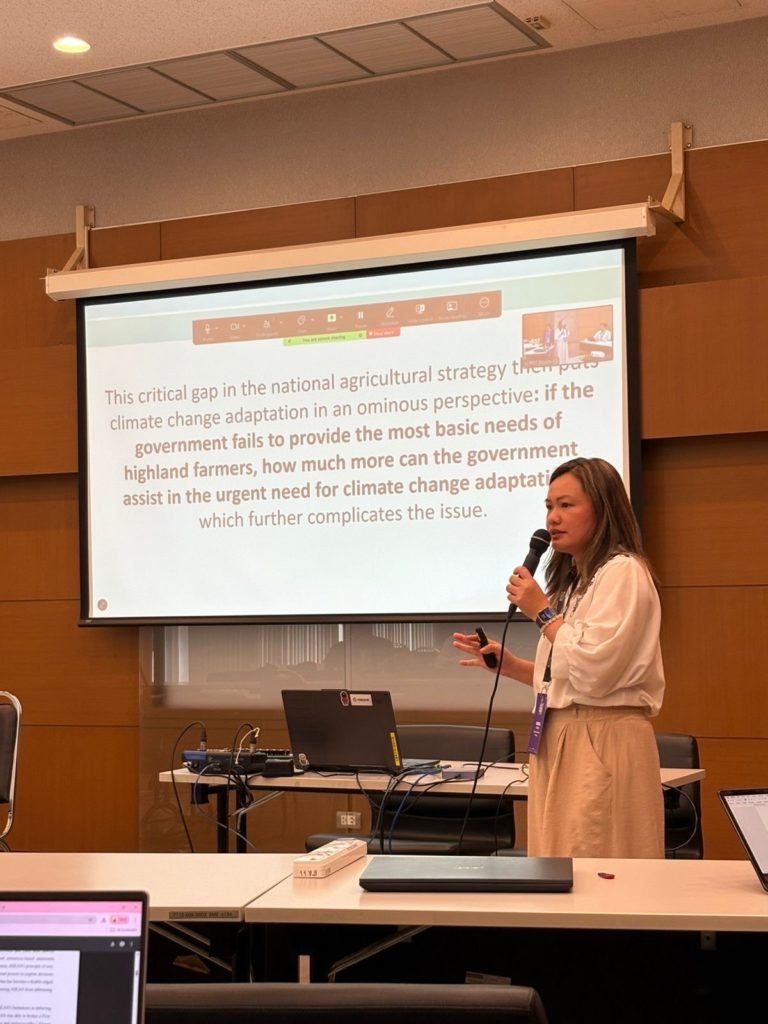
Moreover, farmer organizations were also analyzed as key discursive arenas: although the state perceives these groups as essential in aid distribution, knowledge dissemination, and modernization, there are farmers who identify these organizations as mere instruments that reproduce inequalities in the farming sector. The promulgation of formal and well-established farmer organizations also comes at the expense of informal risk-sharing systems, which are rooted in indigenous customs and values.
In a panel entitled “Towards Just and Sustainable Land Allocation for Displaced Farmers: Climate Change Adaptation in Southeast Asia,” Mr. Francis Uldric San Juan sought to answer this research question: how do indigenous farmers in Atok adapt to climate-induced challenges, while preserving their cultural and ecological practices? The climate storyline of indigenous farmers in Atok, Benguet, revealed that there are physical and socio-cultural dimensions that shape how these communities experience and adapt to the warming climate. Climatic hazards such as typhoons, unpredictable monsoon seasons, and droughts are expected to intensify, while socio-economic factors such as poor market conditions and rampant smuggling are seen to further exacerbate their vulnerability.
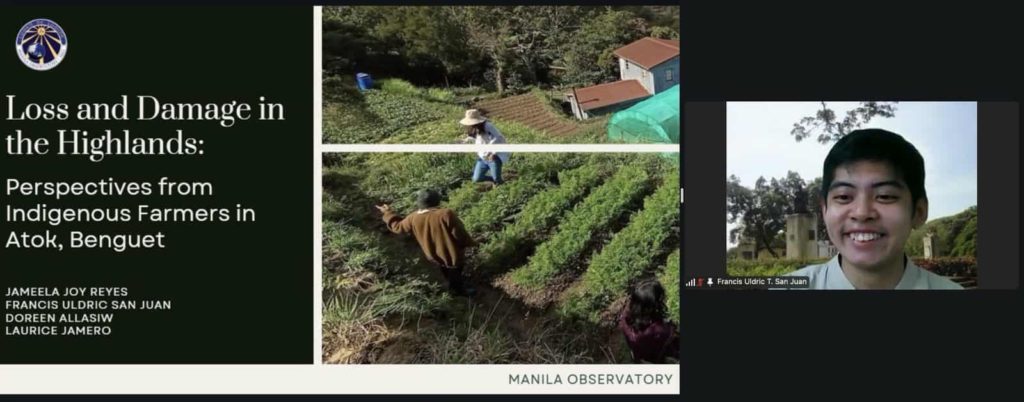
Although farmers attempted to adapt to the warming climate, indigenous communities already incur various forms of impacts: reduced working hours due to higher temperatures, increased frequency of pest infestations, and increased complexity in their planting cycle. Furthermore, government-led adaptation initiatives were also seen to be ineffective as these fail to respond to the actual needs of farming communities.
While employing distinct analytical lenses to understand the experiences of indigenous farming communities in Atok, Benguet, both presentations highlight the importance of climate justice and inclusion. The team’s participation in this conference seeks to amplify the experiences of indigenous farmers at the regional and global levels, consequently shaping how public policy can be crafted to respond to these lived experiences.