
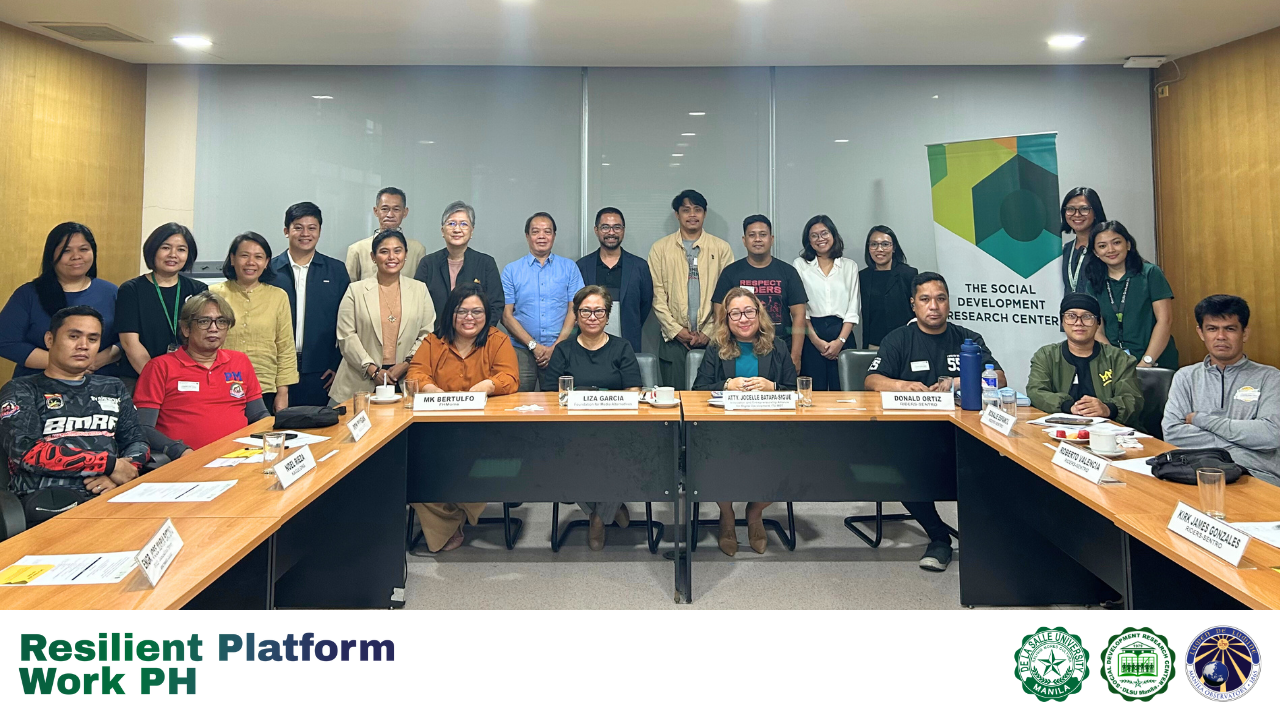
MANILA, PHILIPPINES — The De La Salle University – Social Development Research Center (DLSU-SDRC), in partnership with the Manila Observatory (MO), launched the project Resilient Platform Work PH through a Stakeholders Forum held on June 4, 2025.
The Forum convened experts from government, academia, policy think tanks, NGOs, grassroots actors, and labor organizations to assess the current state of platform work and chart actionable pathways for research and policy development.
Resilient Platform Work PH examines the vulnerabilities of platform workers in the context of severe weather events. The project aims to identify gaps in social protection, develop a skills framework to enhance mobility pathways, and support the creation of governance and policy frameworks that foster a more resilient platform workforce.
Ground truthing platform work across sectors
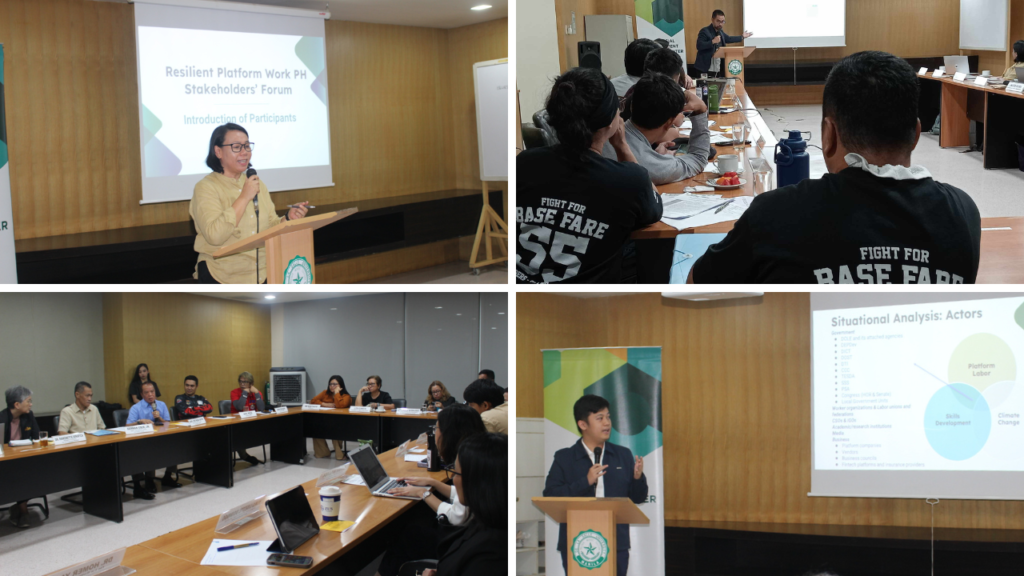
Principal Investigator and DLSU Professor Dr. Cheryll Soriano provided context on the purpose of the project and the Stakeholders Forum. She said, “globally, the Philippines ranks fourth among countries most affected by extreme weather events from 2000-2019, and continually experiences vulnerability to these events that affect many workers and their livelihoods. Along the platform labor economy continues to grow—both for app-based ride-hailing and delivery, or for remote freelance workers—helping address employment gaps and providing opportunities to displaced workers. Yet among the most directly at risk with climate change are these app-based couriers and motorcycle ride-hailing drivers, whose outdoor work makes them particularly susceptible to extreme weather events. Poor public infrastructure and unsafe road conditions compound the impacts of climate change on these workers. Those performing remote tasks from home in extreme heat also face challenges too, such as the need for sustained air conditioning and proper ventilation, which can be both costly and inaccessible for many in countries like the Philippines.”
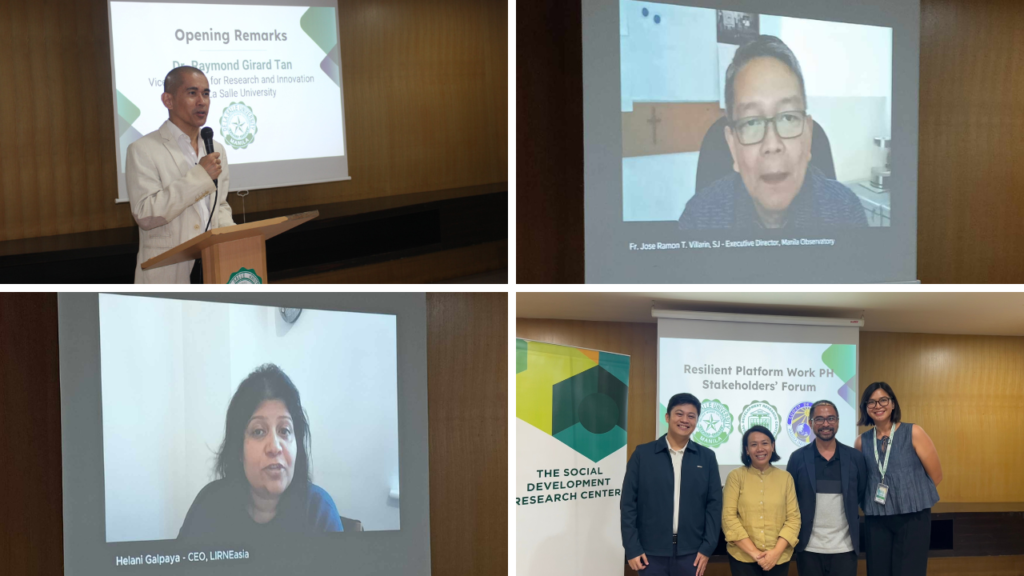
DLSU Vice President for Research and Innovation, Dr. Raymond Tan, opened the Forum by underscoring the importance of research institutions in the country to become knowledge hubs for sustainability issues. He noted that “amid a growing population heavily reliant on such platforms as a primary source of livelihood, this dependence increases their vulnerability, particularly as many lack access to essential protections and adequate healthcare that is worsened by climate change.”
Fr. Jose Ramon Villarin, Executive Director of the Manila Observatory highlighted the critical role of “ground truthing” — ensuring that the lived experiences of those on the frontlines inform research and shape practical interventions. “It is through the voices of key stakeholders who directly encounter these challenges that research can gain depth and relevance, ultimately leading to more effective solutions.”
Charting a just and resilient future for platform work
Co-investigator and DLSU Associate Professor Dr. Jan Bernadas, presenting a situational analysis, emphasized: “rather than viewing platform labor through a generalized lens of precarity, this research explores how specific skills and competencies can also enable workers to negotiate labor dynamics and manage risks and shocks. Given high levels of competition and oversupply locally for ride-hailing and delivery, as well as globally, for remote workers, platform-dependent workers with limited skills will be at risk in the long run. It is essential for us to act now, to understand and address inequalities in skills and competencies across different types of platforms. We need to prepare towards labor mobility that can help them towards diversification or transition to new livelihoods.”
It is for this reason that consulting multiple stakeholders is crucial in order to address the complex intersections of platform work and climate change. As co-investigator and Assistant Director for Policy and Governance at the Klima Center of MO, Atty. Jayvy Gamboa stressed, “We invited you—the experts, industry leaders, and pioneers of platform work to understand how platform work provides a viable source of livelihood, and find out what social support and skills workers require to be able to survive in the context of working within a platform based ecosystem that is also exposed to quick technological shifts and predisposed to the threats of extreme weather events.”
Atty. Gamboa also presented an initial policy situational analysis that highlighted existing policies and legislative proposals that can serve as anchors for the intersections of platform work and climate change. These include the Philippine Development Plan, the Trabaho Para sa Bayan Act and its corresponding Plan, and the Labor Employment Plan 2023-2028.
Insights from stakeholders
The Forum serves as the initial ground for the formation of an Advisory Group that will sustain meaningful dialogues and co-develop policy and governance frameworks across relevant agencies and organizations. Participants included representatives from the Department of Economy, Planning, and Development (DEPDev), the Department of Labor and Employment – Occupational Safety and Health Center (DOLE-OSHC), Filipina Homebased Moms (FHMoms), Foundation for Media Alternatives (FMA), KAGULONG, RIDERS-SENTRO, Philippine Institute for Development Studies (PIDS), Fairwork Philippines, ITU-BDT, and the International Labour Organization (ILO).
Their discussions surfaced perspectives that are critical to be incorporated as the research progresses. This includes a suggestion to think about “resilience” as a scale or spectrum to accommodate different events (e.g., climate events, automation).
One participant shared the need to go beyond physical risks:“We did research about platform riders. One of the things that we looked into was occupational safety, but in the course of data gathering, we found out that many of them experience mental health issues, too. That’s one thing we need to integrate. When talking about climate change and weather disturbances, we tend to focus on the physical conditions, overlooking the mental health aspects.” Workers who invest in vehicles or laptop installments struggle to survive with insecure or seasonal gigs and fluctuating earnings, exposing them to mental health threats.
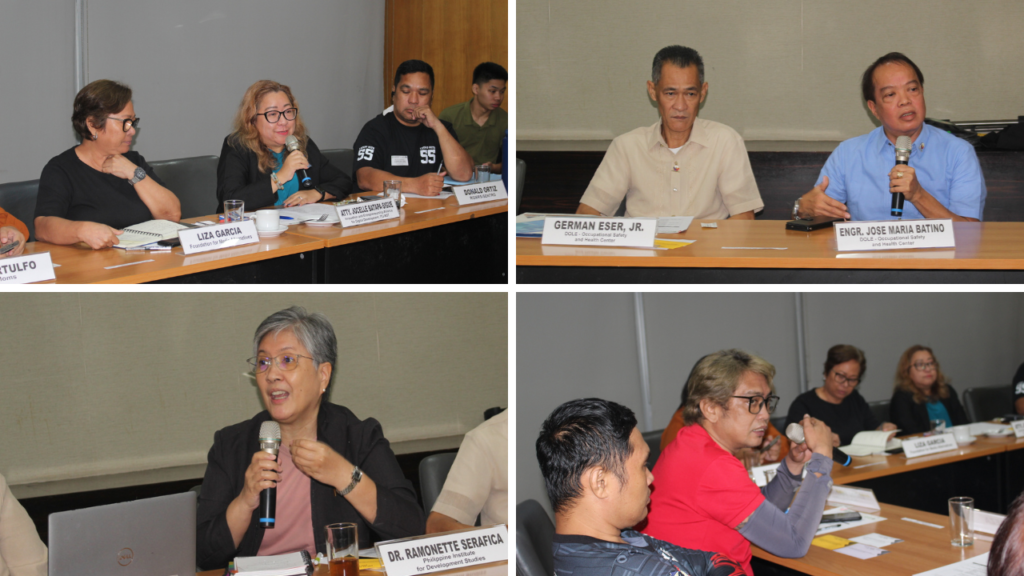
Another participant brought up the need for LGUs and private establishments to provide physical infrastructures to support location-based workers. This includes shelters critical for incidences of extreme weather that workers can use, especially as these workers are sometimes shooed away from restaurants while waiting for deliveries.
Another highlighted the importance of platform-based standards for work in extreme weather such as super typhoons or extreme heat. She said, “currently different platforms follow different standards, with some platforms still accepting and sending workers gigs even when weather situations can be risky and damaging to their vehicles.”
Another important dimension raised is the aspect of gender and soft skills, with a guest highlighting that women thrive in remote work by possessing soft skills. It will be important for the project to create opportunities to learn how workers navigate the platform labor environment and use their knowledge and experiences as take-off point in building a resilience strategy.
Resilient Platform Work PH is part of the FutureWORKS Asia Project, a multidisciplinary research network spearheaded by LIRNEasia and supported by the International Development Research Centre (IDRC) of Canada.
To know more about the latest updates on Resilient Platform Work PH, follow DLSU-SDRC on Facebook and LinkedIn. For any questions about the project, email the Team via resilientplatformworkph@gmail.com or through Dr. Cheryll Soriano at cheryll.soriano@dlsu.edu.ph.