
The 30th Conference of the Parties (COP30) to the United Nations Framework Convention on Climate Change (UNFCCC) was a significant milestone for climate advocacy and negotiations. Notwithstanding widespread criticisms of its failure to integrate language on transitioning away from fossil fuels and reflect on the International Court of Justice Advisory Opinion (ICJ-AO) on Climate Change, among others, this annual summit was still critical in advancing discourse and ensuring action on climate change.
This is especially true for Loss and Damage and Just Transition.
Ten years have passed since Loss and Damage was formally recognized as the third pillar of climate action in the 2015 Paris Agreement, alongside mitigation and adaptation. Since then, both the conceptualization and operationalization of L&D have developed significantly, as manifested in the creation of the Fund for responding to Loss and Damage (FRLD). Meanwhile, Just Transition has gained momentum in climate discourse and practice: governments, practitioners, and advocates have realized that mitigation and adaptation must be just and equitable.
The Manila Observatory, led by Atty. Jayvy Gamboa and Jameela Joy Reyes of Klima Center, seeks to further advance the discourse and practice of L&D and JT, particularly by exploring the climate justice nexus of both fields. Supported by Heinrich Böll Stiftung, their team is currently working on a framework on the interconnection of Loss and Damage and Just Transition. It is asserted that both workstreams can only be fully operationalized and understood if they are rooted in the discourse of climate justice.
COP30, referred to as the “COP of Truth” and the “implementation COP” by many, presented an ideal opportunity for the framework to be shared and discussed. As part of the Manila Observatory’s delegation to the climate summit, Atty. Gamboa spoke at various side events to share the L&D x JT framework with a broad audience of civil society actors, climate advocates, and even decision makers. As each event had specific foci and thematic areas, the knowledge product was explored in various ways: as a guide to climate finance, as a reference for the development of Nationally Determined Contributions (NDCs) and National Adaptation Plans (NAPs), and as a framework in energy transition.
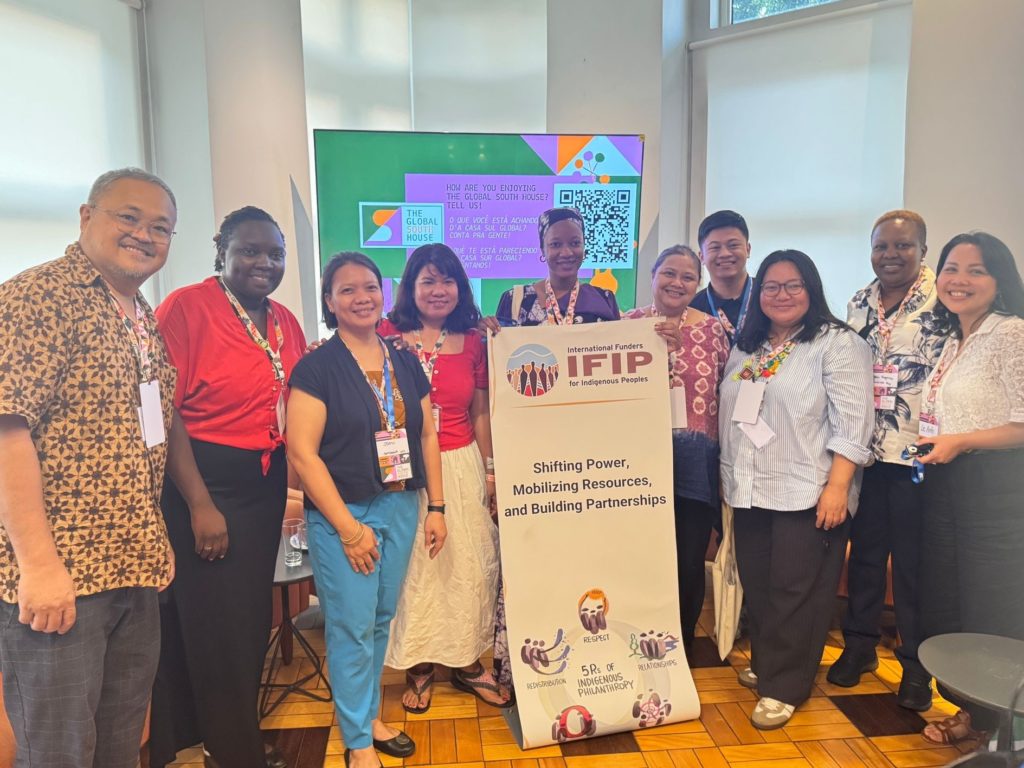
Hosted by the Global South House, the framework was shared at a side session entitled, Funding Food Systems and Resilience in the Global South through Trust-based and Community Philanthropy, on November 17. This event reiterated the importance of ensuring adequate and accessible climate financing schemes, especially for community and grassroots actors. Presenting the L&D and JT framework in the context of climate finance, it was emphasised that resources must be allocated to projects and initiatives that jointly consider both workstreams, especially when these are what communities truly need. These activities holistically consider climate action, consequently empowering communities and ensuring that scarce resources are efficiently utilised.

The day after, the team joined the session named, From Pledges to People: Delivering Resilience that Works, which was organised in the Spain Pavilion. Contributing to the discourse on delivering on climate promises, the L&D and JT framework was proposed as a critical resource that can guide the development of NDCs and NAPs. This framework is not just a conceptual product that grounds both workstreams in the principle of climate justice; rather, it is an actionable tool that can guide decision-makers in crafting policies and action plans.

Finally, to situate the framework in the Southeast Asian (SEA) setting, Atty. Gamboa participated in the side session titled, Leaving No One Behind: Justice and Accountability in the Southeast Asian Energy Transition, held at the ASEAN Pavilion on November 19. Recognizing that SEA nations are quickly transitioning to a low-carbon economy, while simultaneously bearing the brunt of climate impacts, the framework provided an invaluable understanding that synthesizes L&D and JT in the context of energy transition.
The L&D x JT framework promises to provide an innovative and relevant understanding of climate action. Through the publication of this framework, the Manila Observatory seeks to contribute even more to climate discourse and action.